





Factors Behind Kumon’s Overseas Expansion:
Balancing Standardization and Localization
When I began studying the international expansion of edu-businesses, Kumon attracted my attention as a leading example in the field. I reached out to the organization and, beginning around 2008, was given opportunities to interview its employees and instructors. In 2023, I had the chance to visit Kumon operations in Indonesia and the United States.
I learned that the first Kumon Centers serving local learners in Indonesia were established in 1993, shortly after Kumon had gained widespread recognition and begun expanding rapidly in the United States. Since then, the number of centers has continued to grow. Its advertisements were regularly broadcast on television in Indonesia, and I was struck by the high level of brand recognition, particularly in urban areas.
One notable aspect of my visits to Kumon Centers in Indonesia was the standardization of the learning method. Children enter the center, collect their worksheet folders, sit down, complete the worksheets, submit their work for grading, and them move on to the next set independently. This process closely mirrors the practices observed at Kumon Centers in Japan.
Before my visit, I had heard that the Kumon Method originated when Toru Kumon, a high school mathematics teacher, created math worksheets for his son, Takeshi. What surprised me in Indonesia was hearing local employees and instructors, and even parents, refer to “Takeshi” when discussing Kumon. The company’s founding story had become widely shared among those involved with the organization. Through instructor and employee training programs, a museum that presents the company’s history, and informational materials for parents, Kumon shares the story of its origins in Japan, the principles behind its learning method, and the educational philosophy that guides the development of its materials.
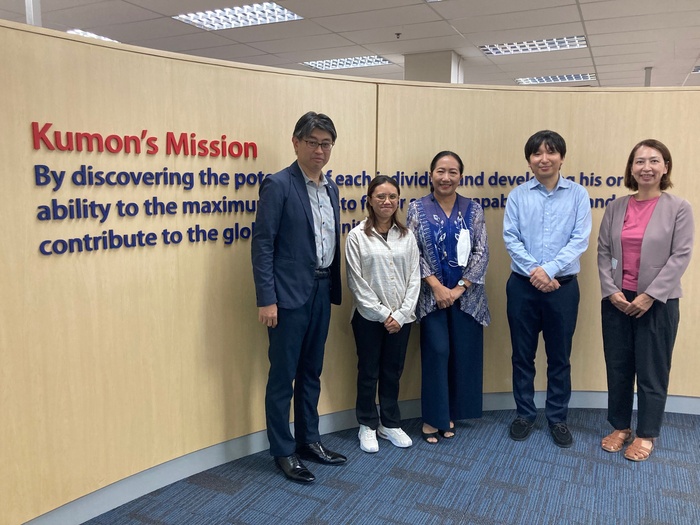
At the same time, the atmosphere of the Indonesian Kumon Centers felt somewhat different from that of their counterparts in Japan. Japanese Kumon Centers are generally very quiet, with children concentrating on their studies from the moment they arrive until they leave. In Indonesia, however, the environment seemed more lively. Instructors and assistants frequently spoke with students, and children who finished a set of worksheets sometimes exchanged a high-five with their instructor. The classrooms were often decorated with photographs and displays, creating a colorful and welcoming atmosphere.
Social media and messaging apps are widely used in everyday communication in Indonesia. Parents of Kumon learners often communicate directly with instructors through messaging apps, and I also heard that some parents communicate with one another through group chats. In addition, because public transportation is not always convenient, many parents bring their children to class by car or motorcycle. As a result, parents often wait at the center while their children study, which naturally creates more opportunities for parents and instructors to engage in face-to-face conversations. Everyday social interactions in Indonesia are often described as lively and conversational, and the atmosphere of the centers I visited may have reflected this broader local culture of communication.
I believe that understanding local cultures and circumstances is important for any foreign company operating an educational business overseas. During an interview in Japan, an employee with experience working abroad emphasized the importance of approaching overseas assignments with respect for local cultures and customs. My observations suggested that the company seeks to adapt to each country by giving local employees and instructors discretion over how to engage with learners and their families.
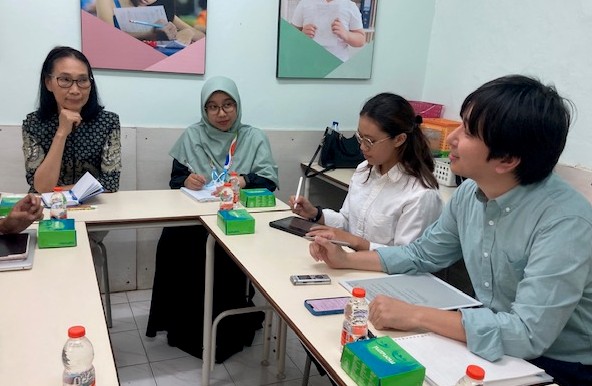
Another aspect that stood out to me was the narratives shared by local instructors. These accounts highlighted aspects of their work that would likely resonate with families. One instructor described working closely with the families of children with disabilities, continually refining her approach through collaboration and trial and error. Another said that one of her greatest sources of motivation came from encountering former learners in everyday places, such as shopping malls, and seeing how they had grown. A third instructor mentioned that she left a career at a major company to pursue work that would allow her to engage directly with children.
Rather than simply exporting a Japanese model, the company appears to be continually seeking the right balance between global standardization and adaptation to local practices. I believe that this approach may be one of the factors that has enabled Kumon to expand into more than 60 countries and regions.
Encouragement and Human Connection:
Even More Important in the Digital Age
In Rehabilitation of ’Learning’: “Imitation and Proficiency”, Professor Masashi Tsujimoto, a historian of Japanese education, discusses the Kumon Method. He explains that the Kumon approach, in which learners read instructional materials independently and acquire knowledge through repetition and practice, closely resembles learning traditions that existed in Japan before modern school education became widespread.
From this perspective, the method can be seen in Japan as an extension of a long-standing learning culture. In Indonesia, however, one former learner viewed the method as “an entirely new way of learning,” because, in her experience, classroom instruction in Indonesian schools often centers on students copying what teachers write on the board, with fewer opportunities to “solve problems independently”. Some instructors and parents also regard the ability to learn independently as an important step toward self-reliance in everyday life. For them, the method is not only a way to acquire academic skills, but also a means of fostering a mindset that encourages children to become more independent. It is interesting that the same educational approach, the Kumon Method, can be interpreted so differently across national and local contexts and among individuals.
The Japan International Cooperation Agency (JICA) regularly organizes a wide range of training programs in Japan. One such program brings together officials from the ministries of education in approximately fifteen countries. Several years ago, I served as one of the coordinators of this program and invited Kumon staff members to deliver a session as guest lecturers. During the session, they presented examples of how Kumon Centers have expanded in various regions worldwide, as well as cases of collaboration with national governments and other public organizations. I felt that the presentations and subsequent discussion provided both the participating officials and the Kumon staff members with a valuable opportunity to reflect on the relationship between public education authorities and private-sector organizations. I believe that, as a first step, it is important for people in different institutional positions to learn about one another’s perspectives.
In today’s world, where digital technologies such as artificial intelligence continue to advance, I believe that these human relationships are becoming even more significant in education. Online education expanded rapidly during the COVID-19 pandemic, but I often hear that learners struggle to continue when studying on their own and may eventually give up. To sustain their learning, they need parents or teachers who support and encourage them, perhaps by saying, “You’re almost there,” as well as friends with whom they can share what they have learned and discuss their concerns. Without this kind of supportive environment, continuing to learn can be difficult. Although online education may appear equally accessible to everyone, it can actually widen disparities between learners who have access to supportive human relationships and those without.
It is also often said that “AI can make education more personalized.” While that may be true to some extent, many generative AI systems are trained on large quantities of English-language data. As a result, AI-driven education could unintentionally reflect educational norms and perspectives rooted primarily in English-speaking contexts. I believe that local knowledge is essential in education, and this issue deserves careful consideration.
When viewed in this light, one of the key challenges for education may be finding the right balance between human interaction and the use of generative AI. I believe that communicating face-to-face, making eye contact, and responding to learners’ emotions remain vital aspects of learning. Prof. Tsujimoto has pointed out that one of the defining features of the Kumon Method is that the people surrounding the learner focus on nurturing motivation and encouraging continued effort. In the years ahead, these human connections and forms of support may become even more important than they are today.
Maintaining a Balanced Perspective and Pursuing Research Grounded in People’s Lived Realities
I believe that learning is about developing ways of seeing the world and building a foundation for thinking. Universities, in particular, provide places where people can cultivate such perspectives. The ability to view things from multiple angles is important even when developing a product or service. A product may make economic sense, but how does it align with laws and public policy? How might society respond to it? Could it create problems in other countries or regions? Our ability to approach such questions from multiple perspectives may determine what becomes possible next. To broaden our perspectives, I believe it is important to take on diverse challenges and learn from them.
In all honesty, I have reached this point while often feeling uncertain about the direction of my life. I struggled with decisions such as where to work and whether to pursue graduate studies. I was particularly torn when deciding whether to move from the corporate sector into academia. Ultimately, however, I concluded that pursuing what I genuinely enjoyed would leave me with the fewest regrets, and I began a new career as an academic researcher.
Research inevitably involves difficult moments. Nevertheless, when an idea genuinely interests me, I often find that I can pursue it for longer than I initially expected. As I continue to explore that interest, the work sometimes leads unexpected encounters and new connections with people.
I therefore encourage you to trust your instincts and pursue what you love. There may be detours along the way, but I believe those experiences help sharpen your instincts. If something sparks your curiosity, give it a try. It is okay to fail. Through my own failures, I feel that I have gradually learned what poses a real risk and what will probably be all right. My parents always watched over me without trying to stop me, no matter what I was doing. I also hope that parents will trust their children with an open and generous spirit and give them the freedom to pursue what they love.
Looking ahead, my immediate goal is to publish a book on edu-business. I am currently preparing the manuscript and hope to publish it within the next year. Building on that work, I hope to collaborate with researchers and practitioners around the world on research into education and business. Rather than reducing private-sector participation in educational development to a simple pro-versus-con debate, I want this research to be grounded in empirical data and attentive to the perspectives and lived realities of people involved.
The world of research itself is also becoming increasingly complex. New methods are emerging, including the analysis of social media data and the quantitative analysis of video content on platforms such as YouTube. Research that crosses the traditional divide between the humanities and the sciences is also expanding, as are international collaborations involving researchers from different countries and regions. Amid these changes, I hope to engage with a wide range of ideas and approaches, maintain a balanced perspective, and continue taking on new challenges.
TAKAMICHI ASAKURA (The IDEC Institute) JST researchmap – Takamichi Asakura
Takamichi Asakura – My portal – researchmap 広島大学 教育開発国際協力研究センター長 吉田 和浩先生(前編)|KUMON now! 広島大学 教育開発国際協力研究センター長 吉田 和浩先生(後編)|KUMON now!
 |
前編のインタビューから -教育社会学の基礎と、グローバルに広がる教育研究の現場 |