



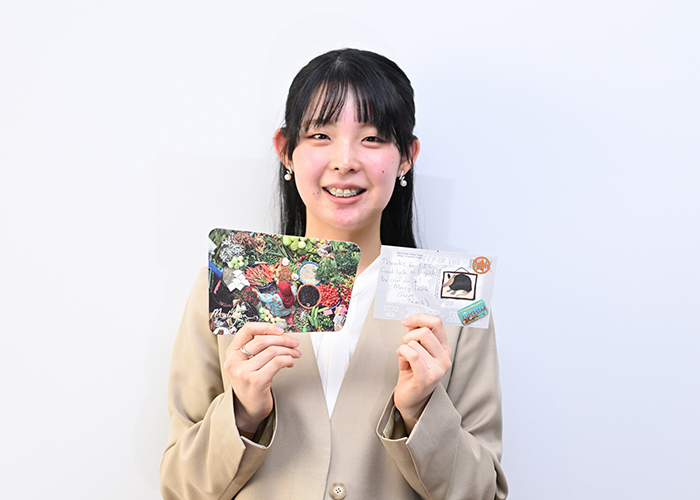


I had been studying English somewhat casually,
and then dove into a sea of vivid sounds and colors
My parents were incredibly relaxed, but perhaps the only time in my life they strongly pushed me was when they urged me to join EIC (English Immersion Camp) [now GIC (Global Immersion Camp)], hosted by KUMON. I was 12, in sixth grade. Until then, I had only studied English through Kumon, and had zero conversation experience. A week-long, English-only camp environment offered nothing but anxiety to me. At first I resisted fiercely, saying, “No way—absolutely not, I’m scared!”
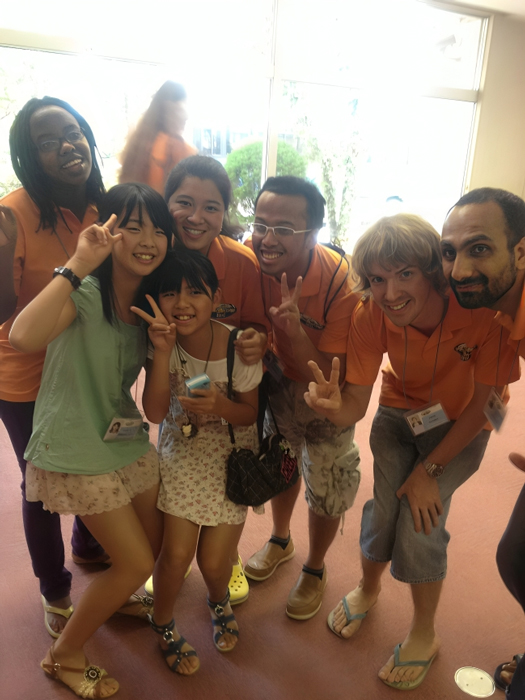
In the end, after being persuaded by my parents, I joined EIC without even knowing the details. Even now I clearly remember the scene the moment I stepped into the hotel lobby that served as the camp venue. Drumbeats thumped—DON-DON-DON—unknown foreign music echoed, and camp leaders from all over the world welcomed us with their best smiles, shouting “Welcome!” The richness of the colors, the strength of the energy… I remember standing there, stunned, feeling both surprised and excited, thinking “This is a place completely different from my everyday life.”
In this camp, the rule is that both children and adults communicate only in English. At first I could hardly understand what everyone was saying, and I couldn’t express what I wanted to say in English. But the camp leaders did not interrupt or correct my desperately squeezed-out, messy English; instead, they leaned forward and listened: “Uh-huh, uh-huh—and then?” I realized that what matters more than correct grammar or pronunciation is the will to communicate. Feeling as if my existence itself was fully affirmed, this experience dramatically changed my introverted nature.
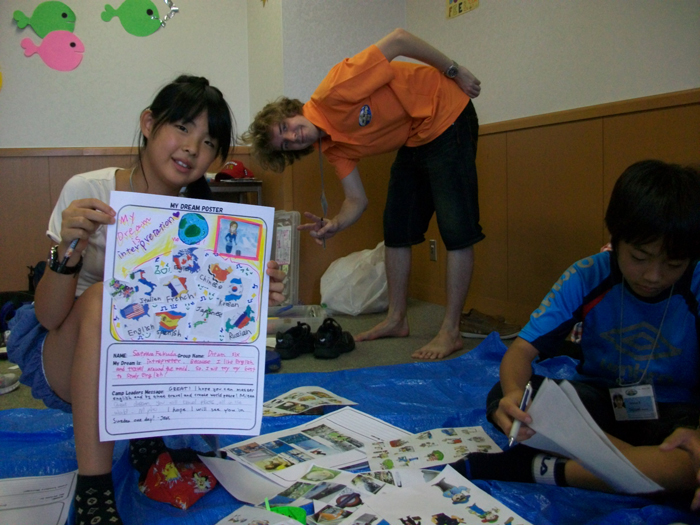
By the second day I gradually got used to conversing in English, and suddenly chatting with everyone became incredibly fun. Looking back, maybe the fact that my ears were already accustomed to English through E-Pencil helped. Thanks to the support of many friends, after dinner I was even able to give a speech that I myself felt satisfied with.
While also feeling the frustration of not being able to put what I wanted to say into words, being able to speak my opinion first, without fear of mistakes, was a major achievement. After the camp, my parents often said in surprise, “You’ve become so proactive!” so I think the change in me was quite noticeable.
Before joining, I couldn’t stand the idea of EIC. But once I stepped inside, the camp was so fun that I felt sad that it had to end, and I couldn’t stop crying on the last day. I clearly remember that at the EIC graduation ceremony not only I, but even my mother, cried our eyes out. And the letter I received from a camp leader at graduation is still my precious treasure.
The uneasiness I felt at an EIC reunion
led to Japanese art becoming my lifelong work
The biggest gift EIC gave me was an intense curiosity about different cultures. During the camp, I encounterede a Muslim camp leader who did not eat during the day because of fasting for Ramadan fasting, and I learned that rules around food differ by country. Differences I could feel in person, not textbook knowledge, ignited my intellectual curiosity.
That curiosity connected to my university research on “engi emaki”, illustrated narrative scrolls about the origins of temples and shrines. Because my mother was an art teacher, I had always liked both drawing and looking at at art, but gradually I became deeply drawn to the relationship between the human heart and religion. I wondered “Why do people believe in something, and depict it in images?”
In fact, when I first entered university, I planned to research Western Christian paintings. Later I changed my major to Japanese art, and the trigger for that was, again, EIC.
When I attended an EIC reunion as a university student and spoke with friends from overseas, I suddenly realized something. I was trying to discuss Christianity, yet I couldn’t richly explain even one thing about my own country’s culture: the appeal of Japanese art. That fact made me feel intensely uneasy. As I confronted the question, “Can you understand other cultures if you cannot speak about your own?”, it pushed me to steer toward research on Japanese art, especially picture scrolls.
Picture scrolls are, in a sense, exactly aligned with the theme of “communication beyond words” that I felt at EIC. As all the points of my experiences connected, I felt I had found “my own field”; something I should devote my entire life to.
With kind, simple words,
I want to serve as a bridge that connects museums to the world
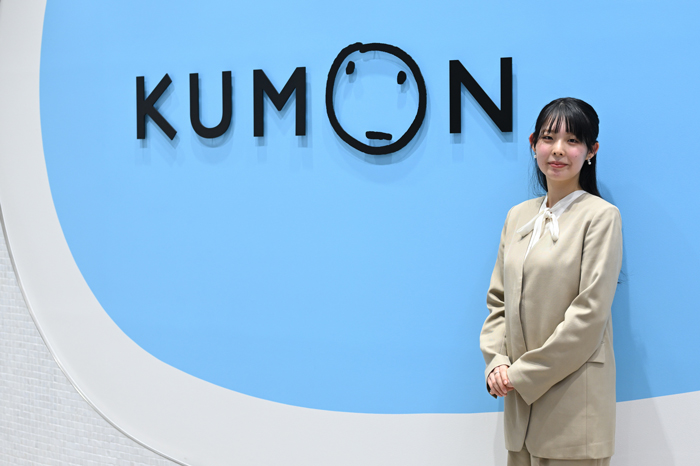
I’m about to enter my second year as a curator, and I have a dream: to lower the barriers to museums and convey the appeal of art to more people.
When researchers talk among themselves, the use of specialized terms inevitably increases. But such conversations won’t reach first-time visitors, small children, or tourists from overseas. Multi-language signage is also still a work in progress. Using the summarizing skill I learned through Kumon and the courage to communicate I learned through EIC, I want to share kind, easy-to-understand explanations that anyone can follow.
The other day, when I created a flyer for a Japanese painting exhibition I was in charge of, the initial policy was to prioritize the volume of information and use Japanese only. But many international tourists visit Kyoto. I felt that “Japanese paintings should be a major attraction for them too. It would be a waste to miss this opportunity. We must include English!” I worked hard with a colleague from China to persuade our supervisor.
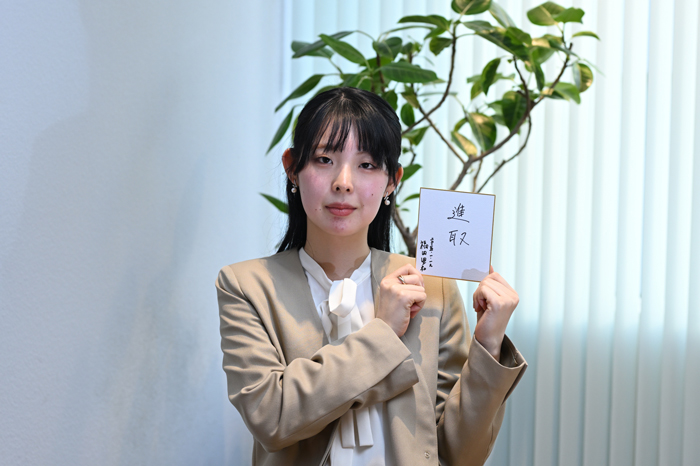
As a result, our proposal was adopted, and English exhibition information was added to the flyer. By acting on my own will, I was able to open up the museum just a little bit more to the world. The sense of progress was an irreplaceable joy. At the same time, I feel deep gratitude for a workplace environment that respects even a first-year newcomer’s opinions.
Looking back again, I truly feel that all experiences are connected. The competitive me who solved worksheets while crying, and the 12-year-old me who was terribly afraid of English: both are precious parts of who I am today.
I’m sure many unknown doors will appear in front of me from now on, but I want to keep challenging myself without fear. And I want to convey the appeal of artworks to people around the world. Someday, I want to create an exhibition plan that makes people think, “If this person is planning it, it sounds interesting!”
Parent’s comment
My daughter, who has always loved reading, began to try many different things after participating in EIC. What made me happiest as a parent was that it wasn’t forced; it felt very natural for her.
She sometimes gets overwhelmed because she has too many interests and things she wants to do.
Still, I am proud that she has found something she can be truly passionate about as her profession.
Kumon English Immersion Activities | Kumon English Immersion Activities (kumon-eia.com) What is Global Immersion Camp (GIC)?
KUMON Global Immersion Camp GIC (English Camp) | Kumon English Immersion Activities (kumon-eia.com) Global Immersion Camp (GIC) 2025
Global Immersion Camp 2025 Completion Report | KUMON now! Topics
 |
From Part 1: – A curator’s daily life behind the glamour, where multi-tasking is essential |