






A curator’s daily life behind the glamour,
where multi-tasking is essential
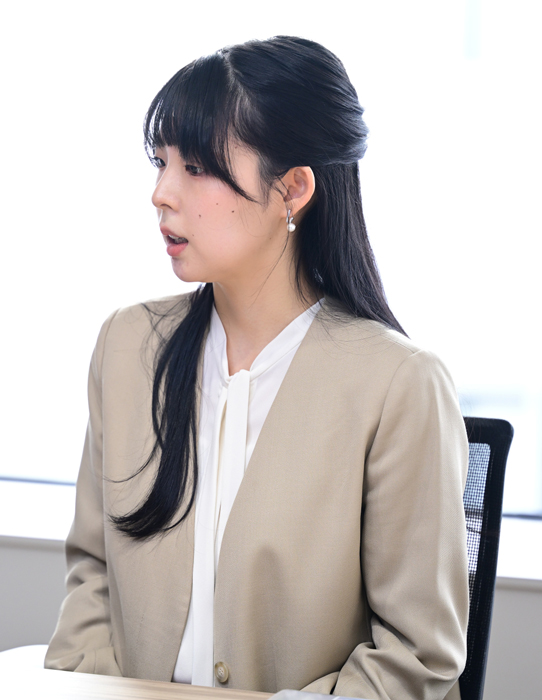
It has almost been a year since I started working as a curator at an art museum in Kyoto City. Until last year, I worked as a curatorial assistant while studying in graduate school. My area of responsibility is modern Japanese paintings. My mission is to explore how to convey the beauty and excellence of the works in the museum’s collection to as many people as possible and to maintain them for future generations.
When you hear “curator,” you may imagine glamorous work such as planning and managing exhibitions or giving gallery talks (artwork explanations) in the exhibition rooms. In reality, however, most of the work happens behind the scenes. At its core is steady research.
For example, when the year of a work’ creation is unknown, we curators examine art magazines and newspaper articles from the time and scour every possible source, including the artist’s memoirs. Then, by filling in the pieces like a puzzle, for example “If an illustration appeared in the newspaper on this day, it must be from this period!”, we dig deeper and deeper into information related to the work.
Curators are researchers, but also administrators and public relations staff. From checking artworks and requesting restoration work to preparing documents to submit to the City of Kyoto, every day requires multi-tasking. To be honest, this past year has been a struggle for me to switch between all these tasks and move them forward. At the same time, the forefront of my mind is constantly packed with things like next month’s special exhibition, the permanent exhibition six months from now, and next year’s budget plans.
Even so, for someone like me who has been so captivated by artworks that I feel I couldn’t live life without touching art, being a curator is an irreplaceable job that allows me to engage with artworks up close. During graduate school, when I worked part-time at a museum and helped at an art restoration site, I had the experience of closely viewing and touching works that are usually separated from viewers by glass cases. In that moment, I was overwhelmed by the energy radiating from the real works, and became completely fascinated. That’s when I decided to pursue the path of being a curator, something I had never even considered before.
However, many people who aim to become curators obtain the qualification while they are undergraduates. I had started quite late, so I was extremely busy, taking master’s course classes while also working hard to earn my curator qualification. Even so, I believe that the reason I was able to keep challenging myself without giving up to achieve my dream, and the reason I can keep up with my work today, is thanks to three abilities I gained through Kumon in childhood.
Worksheets wrinkled by frustrated tears
nurtured a never-give-up mindset
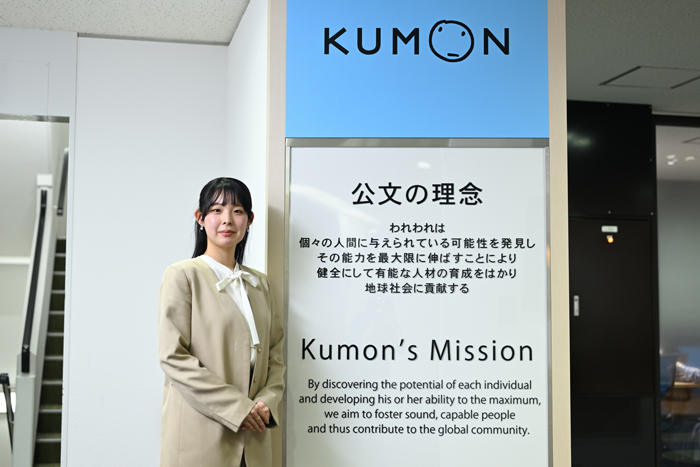
I remember starting to attend a Kumon center around my last year of kindergarten. In fact, my grandmother was a Kumon instructor, so even before I can remember, our home was full of Kumon materials, and it seems I worked on “connect-the-dots” worksheets (which are early handwriting practice worksheets) as part of playing. So I don’t know exactly when I started Kumon.
With no clear boundary between play and study, solving worksheets became an ordinary part of life before I knew it. Then one day I hit a wall, when complicated calculations like “5-digit ÷ 3-digit” appeared in math. Until then I had been solving sums smoothly, but it suddenly started taking 20 or 30 minutes just to finish one sheet and correct my mistakes. No matter how many times I tried, I couldn’t get 100 points. It was frustrating.
Even now my younger sister laughs and says, “Back then you would crumple up the worksheet, sulk and go to bed, then painstakingly smooth it out yourself and redo it while crying.” I don’t personally remember crying, but I think that competitive, never-want-to-lose nature is at the core of who I am.
One of the great things about Kumon is that no matter how long it takes, you’re allowed to keep going until you solve it through your own effort, so you develop perseverance. That was the first ability I gained through Kumon. Even with materials I struggled through, once I truly understood them, the next time I could solve them smoothly.
Because I experienced firsthand how ability takes root through repeated practice, I came to believe, in anything I do, “Even if I don’t understand it now, if I keep engaging without giving up, I’ll surely reach the answer.” The research approach I use today—slowly reading through tens of thousands of words in papers and past documents—may be an extension of those frustrated tears.
Setting expectations like “five sheets in 20 minutes”:
Objective self-analysis

The second ability I gained through Kumon is concentration. Each Kumon homework set was about five sheets, and I always thought about what time of day would be best to do them. I would first set an expectation, such as “This unit should be finished in under 20 minutes,” or “I’m good at Japanese, so I can finish in 10 minutes.” Then I would tackle it in small time frames, for example before morning radio exercises during summer vacation, or after school before friends came over, thinking, “Let’s just finish it in this short free time!” I believe that is how I naturally developed the ability to concentrate intensely for short periods.
At the same time, even as a child I understood that I wasn’ the type who can keep concentrating for a long time. If my focus runs out after 30 minutes, then I should take a walk and reset; I knew that was my best method. Because I could analyze myself through Kumon homework, I think I was able to maintain my own pace through self-study in high school without going to cram school.
The third ability is summarizing. In my third year of junior high, my grandmother told me that what matters in Japanese is summarizing. No matter how long the text is, the ability to grasp concisely what the author wants to convey and what the basis is what defines summarizing, and that is Japanese language ability. And she said Kumon worksheets train that. I was happy when she watched me solving Japanese worksheets and praised me, saying, “Satowa, you’ve developed strong summarizing skills.”

Looking back now, the perseverance, concentration, and summarizing skills I gained through Kumon may have, without my noticing, developed into the ability to quickly grasp the essence of things.
The first time in my life I jumped into a completely unpredictable world was the summer of my sixth grade year in elementary school. My parents, who were usually very hands-off, unusually encouraged me strongly to attend KUMON’s English camp, EIC (English Immersion Camp). Through one week of EIC, my still-narrow perspective would open up to the world all at once.
Kumon English Immersion Activities | Kumon English Immersion Activities (kumon-eia.com) What is Global Immersion Camp (GIC)?
KUMON Global Immersion Camp GIC (English Camp) | Kumon English Immersion Activities (kumon-eia.com) Global Immersion Camp (GIC) 2025
Global Immersion Camp 2025 Completion Report | KUMON now! Topics
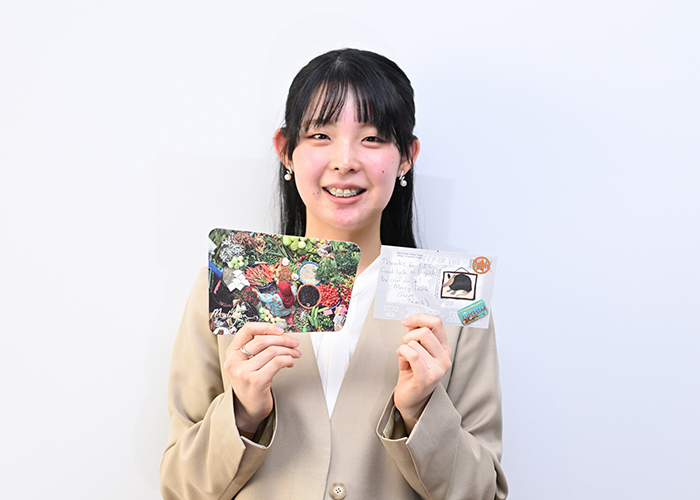 |
From Part 2: – I had been studying English somewhat casually, and then dove into a sea of vivid sounds and colors Part 2 continues (coming soon) |