





Making Social Issues Visible Through Planning

I currently work in the planning division of a newspaper company. The themes I handle are social issues such as sustainability, diversity, and education. In collaboration with people from many sectors, including business, government, academia, and NGOs, I plan study sessions, symposia, and print/web content.
A single project lasts several months at the shortest, and more than a year at the longest. My job is to produce the entire process, from venue design and speaker selection to reporting and page production, so that social issues are made visible.
My current special focus is DE&I (diversity, equity, and inclusion). For people with diverse backgrounds to be naturally and fairly accepted by society, we must change not only systems and mechanisms but also the “atmosphere”—the collective mindset. That cannot be done overnight. Precisely for that reason, I value creating spaces where people from different standpoints can talk and gradually develop mutual understanding.
This work is most rewarding when I witness someone’s values or behavior shift, even a little. For example, when a corporate leader says, “Empowering diverse talent actually becomes an engine for management.” When I see that awareness lead to the next action, I feel like a seed that transforms society has sprouted and is growing.
Working with social issues means dealing with a world without clear answers. That’s why a perspective of “designing change” over the long term without rushing is essential. On the first page of every proposal, I make a point of writing: “Which problem are we trying to solve?” Thinking that through is the starting point of everything.
Daily operations can be full of deadlines and numbers, but at the core is connecting people and society for the better. That’s why I keep doing this work. A society where people recognize differences and live together: this is less an “ideal” than a “mission” to me.
A Kumon Center Where I Encountered Diversity
and First Felt the World Expand
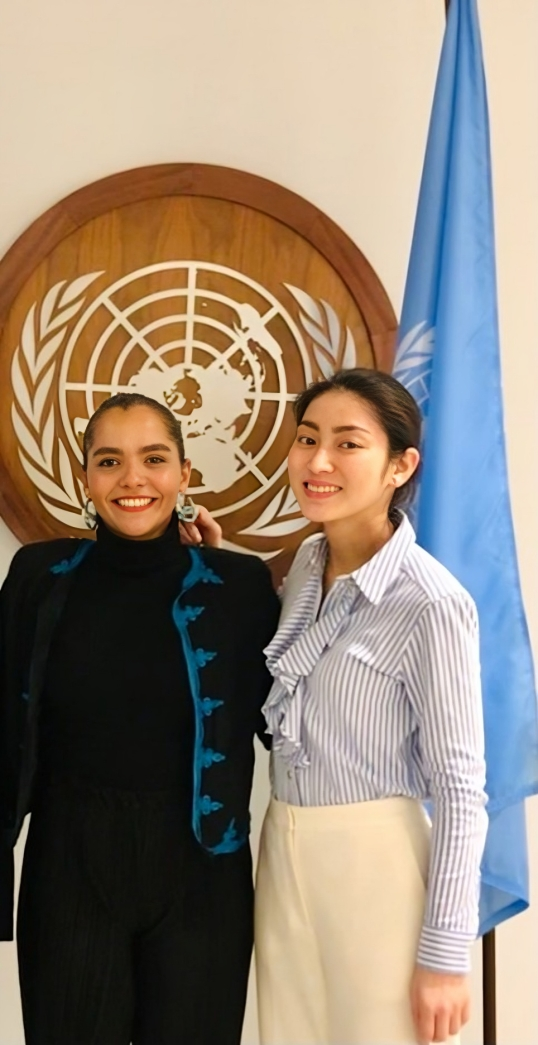
Looking back, the source of my interest in “work that connects people” lies in the learning experiences I had from childhood. The sense of an expanding world I felt at my Kumon Center has become the core of my values today.
The Kumon Center I attended was in a residential area of Utsunomiya City, Tochigi. Yet inside that small center, it was like a microcosm of the world. Children of expatriates from the U.S., Thai students, Korean students learning Japanese, students of different nationalities and ages studied at the same tables. It was a place where you naturally exchanged words and learned together with people you wouldn’t readily meet at school. Inside the center, difference was simply normal.
As a child I didn’t find that scene strange; I took it as natural that there were no barriers to learning. Looking back, that was a significant experience for me. “People are all different and that’s okay.” I think that feeling had already taken root in me then. The learning environment of those days is the origin of my current interest in a multicultural, coexistent society.
The content of study itself also laid an important foundation for me. I studied three subjects, mathematics/arithmetic, English, and Japanese, and especially in English I progressed up to the final research materials. I tackled not only worksheets, but also flashcards, the Zun-Zun materials, and reading aloud. I remember multi-sensory learning as being fun. Sitting down to study wasn’t a burden, and the feeling of “I want to know more” continued naturally.
Kumon’s worksheets for Japanese as a native language were filled with “living words.” For example, the stories of people who acted for others like Mother Teresa, Dr. Martin Luther King Jr., and Sadako Ogata. As I read them aloud, each of their words stayed with me.
“I believe words have the power to move people’s hearts.” I think I first felt that through those worksheets. This awareness of valuing words is something I always keep in mind today when I plan and communicate.
Above all, through Kumon I acquired the ability to proceed at my own pace. Unbound by age or grade, moving even a little beyond yesterday’s self, those small accumulations gave me the courage to take on challenges. The balance of security and stimulation I felt in that Kumon center still lives within me as a sense that “learning is fun.” The center was not only a place to study; it was also a place to meet people and find prompts for thinking.
Joining GIC:
A Summer When I Perceived the World in English
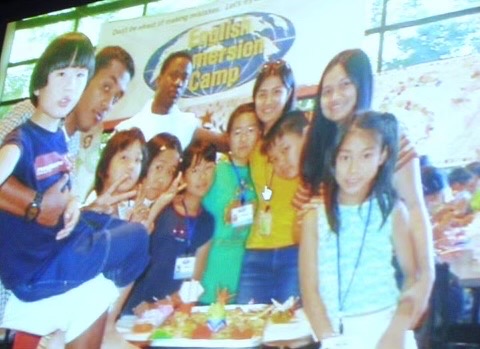
In the summer of fourth grade, I joined Kumon’s Global Immersion Camp (GIC) then known as English Immersion Camp (EIC). I had just passed Eiken Grade 4. I loved English and my greatest wish was to be able to speak it. My Kumon instructor encouraged me to apply.
The moment I stepped into the GIC venue, I literally experienced my world expanding. Standing before me were people with different skin tones and languages, and I vividly remember feeling, “There are so many worlds here.” Until then, I had regarded English as an academic subject. At GIC, that completely changed.
The entire camp was conducted in English. Every day we communicated through songs, dance, games, and discussions. In an atmosphere where you could make mistakes and laugh together, I felt in my body that “English is a tool to connect with people.”
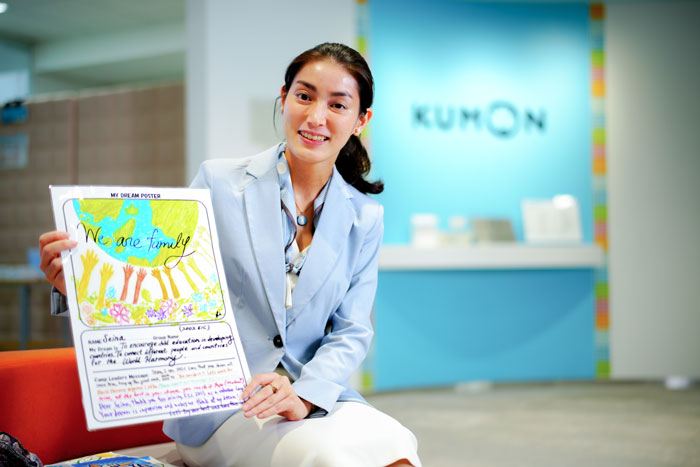
zears wouldn’t stop. The sense that “the world and I are connected,” which I felt then, has become a starting point I recall many times in my life.
A Filipino camp leader I met there, Marian, changed my life. One day during GIC she said, “It’s an amazing thing to be able to go to school every day.” At the time I didn’t understand why that was amazing. As I listened, I learned that many children around the world can’t access education, and I began to ask, “Why?”
That question led me to an interest in social issues and international cooperation. Later, I learned that Marian went on to study at a University in London, and I decided to aim for the same university for my undergraduate study in International Relations.
The two weeks I spent at GIC did more than improve my English; they nurtured my ability to “make the world my own concern.” The joy of learning, the courage to challenge myself, and the delight of connecting hearts across cultural differences; all of these connect to the way I live now.
 |
From the later-part interview -How Kumon experiences live on today: the power to communicate and embrace |